“a deterministic, physics-driven computational engineering AI”
actually mean?


What does
“a deterministic, physics-driven computational engineering AI”
actually mean?
Let’s break it into three words, with concrete examples.
1️⃣ Deterministic = “Same input → same result”
Beginner example
If I say:
- 2 + 3 = ?
A calculator will always give 5.
That’s deterministic.
Now compare that to:
- “Draw a cool rocket nozzle”
An image AI might give you different shapes every time.
That’s non-deterministic.
Leap71’s AI works like the calculator, not like the image AI.
- Same thrust
- Same chamber pressure
- Same propellant
➡️ Exactly the same nozzle geometry every time
No guessing. No randomness.
2️⃣ Physics-driven = “Rules of nature are hard-coded”
Beginner example
Think about designing a water pipe.
Physics rules say:
- If the pipe is too thin → pressure loss increases
- If flow speed increases → friction losses increase
A human engineer knows this.
Leap71 does not let AI “learn this from data”.
Instead, engineers write these laws directly into the code.
For a rocket nozzle, the AI uses:
- Gas expansion equations
- Conservation of mass & energy
- Heat transfer equations
- Material temperature limits
So the AI is not inventing shapes.
It is calculating the only shape that physics allows.
3️⃣ Computational engineering AI = “An engineer made of code”
This is the key idea.
Instead of:
- A human drawing CAD
- Then checking with CFD
- Then fixing mistakes
Leap71 uses software (called Noyron) that acts like:
“A junior engineer who never gets tired and knows all equations perfectly”
What this AI does automatically:
- Computes nozzle contour
- Sizes throat and expansion
- Designs cooling channels
- Checks material limits
- Outputs manufacturing-ready geometry
Humans don’t draw.
Humans define the problem.
Concrete aerospike nozzle example
Let’s say the requirement is:
- Thrust: 5 kN
- Chamber pressure: 50 bar
- Propellant: LOX / kerosene
- Must work from sea level to vacuum
What a human does
- Decides these requirements
- Encodes rocket physics into the AI
- Says “optimize for performance + cooling safety”
What the AI does
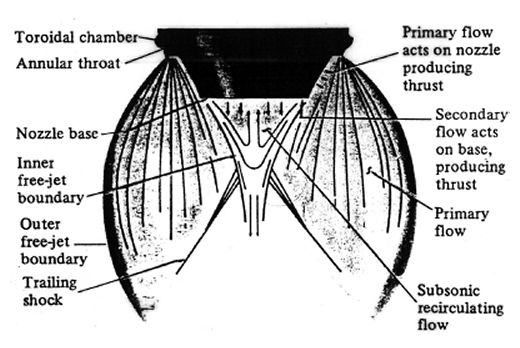
- Computes the aerospike contour
- Designs the toroidal combustion chamber
- Calculates cooling channel size and layout
- Produces a single 3D-printable engine
No trial-and-error sketches.
No neural network guessing.
That’s why Leap71 hot-fired their aerospike successfully on the first try.
One ultra-simple sentence (for beginners)
This AI doesn’t “imagine” designs — it “calculates” them using physics, every time, exactly.
コメント