- Executive summary
- Scope & method
- Paper inventory table
- Institution summary table
- Cross-paper analysis and trends
- Autonomous multi-agent turbine design architecture
- Prompt analysis and improved prompts
- Strategic insights and research directions for industrial turbine applications
- A publicly available paper (PDF)
Executive summary
Across AIAA conference publications in 2024–2025, “generative AI” appears in two dominant clusters: (i) generative geometry / design-space construction (diffusion, GAN/AAE/VAE, DDPM-conditioned synthesis) and (ii) LLM-centered engineering workflows (RAG, domain fine-tuning, evaluation/benchmarks, agentic orchestration). A third cluster is AI-accelerated CFD / solvers, where “generative” is sometimes literal (diffusion/flow reconstruction) but more often practical: physics-informed neural operators/solvers, shock-processing ML, and super-resolution–informed AMR. Representative design-generation works include diffusion airfoil samplers and latent diffusion conditioned on flow constraints 1 and DDPM-based synthesis for full-aircraft configurations (e.g., blended-wing-body geometry generation conditioned on aerodynamic targets). 2
On the LLM side, the 2024–2025 AIAA set spans (a) domain LLMs and fine-tuning for aviation text and QA, 3 (b) RAG and knowledge-graph grounding/trust, 4 (c) benchmarks and evaluation sets for aerospace/aviation language use, 5 and (d) agentic / workflow engines that translate natural-language intent into executable engineering pipelines. 6
For industrial turbomachinery implications, the strongest near-term pattern is not “diffusion-designed turbine blades” (still sparse in 2024–2025 AIAA open literature), but tooling: LLM-mediated orchestration of meshing/CFD/optimization and provenance-aware workflow engines (both relevant to turbine aero/thermal design stacks). 7 The major technical gap, relative to industrial TRL, is closed-loop, constraint-verified generative design (geometry + operability + aero/thermal/structural constraints + manufacturability) with defensible validation beyond simulation. 8
Scope & method
This report targets AIAA conference/meeting papers in 2024–2025 (SciTech; Aviation/ASCEND; and adjacent AIAA meeting-paper venues) that explicitly involve generative AI (diffusion/DDPM/score-based; GAN/AAE/VAE; normalizing flows), LLMs/RAG/agentic systems, and surrogate/physics-informed models when used for generative or solver-acceleration roles. Evidence was prioritized in this order: (1) accessible AIAA/ARC pages and PDFs, (2) author/institution PDFs (e.g., École polytechnique fédérale de Lausanne Infoscience; NASA Technical Reports Server PDFs; German Aerospace Center eLib), and (3) arXiv preprints when they correspond to the AIAA DOI-labeled paper. When a field could not be validated from a cited primary source, it is marked “unspecified.”
Interpretation rule for evidence in the inventory table: for each paper, all non-“unspecified” extracted attributes are derived from the row’s Evidence sources; if the evidence does not support an attribute, it is left “unspecified.”
Paper inventory table
Primary categories (one each): generative design; physics-informed generative models; surrogate modeling; multi-agent design automation; AI-driven CFD acceleration; LLM-assisted workflows; digital twin + generative.
Abbreviations: Phys-int = black-box (BB) vs physics-embedded (PE). Val = simulation / experiment / both / unspecified. TRL = research / prototype / applied (inferred from validation + deployment cues; where inference is made, it is justified). Geom = direct / parameterized / NA. CFD-loop = yes/no/unspecified. Agents = yes/no/unspecified.
| ID (DOI) | Year | Venue | Title | Key authors | Primary category | Core methodology | Phys-int | Val | TRL (justification) | Geom | Determ. vs stoch. | CFD-loop | Agents | Evidence |
|---|---|---|---|---|---|---|---|---|---|---|---|---|---|---|
| 2024-0037 (10.2514/6.2024-0037) | 2024 | unspecified | Generative Adversarial Networks for the Inverse Design of 2D Metamaterials | unspecified | generative design | conditional GAN inverse design | BB | simulation | research (simulation-focused meeting paper) | direct | stochastic | NA | no | 9 |
| 2024-0685 (10.2514/6.2024-0685) | 2024 | unspecified | Physically interpretable airfoil parameterization using VAE-based generative modeling | Yu-Eop Kang et al. | surrogate modeling | physics-aware VAE; latent aligned to thickness/camber factors | PE | simulation | research (method + comparative studies; no operational deployment claimed) | parameterized | stochastic | unspecified | no | 10 |
| 2024-0686 (10.2514/6.2024-0686) | 2024 | unspecified | Towards Universal Parameterization: Using Variational Autoencoders to Parameterize Airfoils | K Swannet et al. | surrogate modeling | VAE airfoil parameterization | BB | simulation | research (parameterization study) | parameterized | stochastic | unspecified | no | 11 |
| 2024-0914 (10.2514/6.2024-0914) | 2024 | AIAA SciTech | Usage of ChatGPT for Engineering Design and Analysis Tool Development | K. C. Pierson et al. | LLM-assisted workflows | ChatGPT-assisted tool/code development; OpenMDAO explanations; applied to fan-blade optimization | BB | simulation | prototype (implemented workflow/tooling; no operational deployment) | NA | unspecified | yes (optimization workflow) | no | 12 |
| 2024-0917 (10.2514/6.2024-0917) | 2024 | AIAA SciTech | Enhanced Workflow Management using an Artificial Intelligence ChatBot | Stanislaus Reitenbach et al. | multi-agent design automation | chatbot-driven workflow engine to translate NL into workflow instructions | BB | unspecified | prototype (workflow engine concept + case framing) | NA | unspecified | yes/unspecified | yes/unspecified | 13 |
| 2024-1054 (10.2514/6.2024-1054) | 2024 | AIAA SciTech | Transforming System Modeling with Declarative Methods and Generative AI | J Fuchs et al. | LLM-assisted workflows | LLMs automate model creation in declarative framework | BB | unspecified | prototype (automation concept; not validated as deployed system) | NA | unspecified | NA | yes/unspecified | 14 |
| 2024-1361 (10.2514/6.2024-1361) | 2024 | AIAA SciTech | Coarse-Grid Large-Eddy Simulation by Unsupervised-Learning-Based Sub-Grid Scale Modeling | Soju Maejima et al. | AI-driven CFD acceleration | unsupervised ML SGS modeling for very coarse LES | PE/unspecified | simulation | research (simulation method paper) | NA | unspecified | yes (LES context) | no | 15 |
| 2024-1362 (10.2514/6.2024-1362) | 2024 | AIAA SciTech | Reconstruction of high-resolution turbulent flow fields from sparse measurement using diffusion normalizing flows | unspecified | AI-driven CFD acceleration | diffusion normalizing flows for high-res field reconstruction from sparse/low-res | BB | simulation | research (reconstruction study) | NA | stochastic | no/unspecified | no | 16 |
| 2024-1528 (10.2514/6.2024-1528) | 2024 | unspecified | Development of a Commercial Airplane Certification Digital Assistant Using a Large Language Model Trained with Regulatory Requirements and Means of Compliance Documents | T. C. DePauw et al. | LLM-assisted workflows | LLM-based certification compliance assistant (“CertifAIer”) trained on regulatory/MoC docs | BB | unspecified | prototype (assistant tool described; deployment not evidenced) | NA | unspecified | NA | yes/unspecified | 17 |
| 2024-2013 (10.2514/6.2024-2013) | 2024 | AIAA SciTech | Optimizing Diffusion to Diffuse Optimal Designs | Cashen Diniz; Mark Fuge | physics-informed generative models | latent denoising diffusion model conditioned on flow + area constraint; used for design generation | BB | simulation | research (generative model + design study) | direct | stochastic | unspecified | no | 18 |
| 2024-2702 (10.2514/6.2024-2702) | 2024 | AIAA SciTech | Adapting Sentence Transformers for the Aviation Domain | Liya Wang et al. | LLM-assisted workflows | domain-adapted sentence transformers; TSDAE pretraining + fine-tuning | BB | unspecified | research (NLP method evaluation; not a deployed ops system) | NA | deterministic/unspecified | NA | no | 19 |
| 2024-3665 (10.2514/6.2024-3665) | 2024 | unspecified | SDF-GAN: Aerofoil Shape Parameterisation via an Adversarial Auto-Encoder | T Bamford et al. | generative design | adversarial autoencoder with signed-distance-function (SDF) representation | BB | simulation | research (parameterization + optimization context) | parameterized | stochastic | unspecified | no | 20 |
| 2024-3667 (10.2514/6.2024-3667) | 2024 | unspecified | A Fully Data-Driven Generative Design Routine for Subsonic Airfoils Based on Adversarial Autoencoders | Pedro d. Secchi et al. | generative design | adversarial autoencoder; latent low-dim encoding replicating airfoil geometries | BB | simulation | research (data-driven generative routine) | direct/parameterized | stochastic | unspecified | no | 21 |
| 2024-3734 (10.2514/6.2024-3734) | 2024 | unspecified | Reinforcement Learning for Cognitive Detection and Countermeasure Generation | R Thummala et al. | physics-informed generative models | RL combined with GANs for adaptive detection/countermeasure generation | BB | unspecified | research (algorithmic study) | NA | stochastic/unspecified | NA | unspecified | 22 |
| 2024-3754 (10.2514/6.2024-3754) | 2024 | unspecified | Airfoil Brain: Deep Learning-Based Airfoil Design Optimization | G. Doan et al. | surrogate modeling | deep ensemble surrogate + VAE parameterization for airfoil optimization | BB | simulation | research (surrogate design optimization) | parameterized | stochastic/unspecified | yes/unspecified | no | 23 |
| 2024-3755 (10.2514/6.2024-3755) | 2024 | unspecified | DiffAirfoil: An Efficient Novel Airfoil Sampler Based on Latent Space Diffusion Model for Aerodynamic Shape Optimization | Zhen Wei et al. | physics-informed generative models | diffusion in automatically learned latent space; airfoil sampling for ASO | BB | simulation | research (sampling + ASO framing) | direct | stochastic | unspecified | no | 1 |
| 2024-3839 (10.2514/6.2024-3839) | 2024 | unspecified | DeepGeo: Deep Geometric Mapping for Automated and Effective Parameterization in Aerodynamic Shape Optimization | Zhen Wei et al. | surrogate modeling | neural-network-based automatic parameterization (“DeepGeo”) for complex geometries; mesh deformation integration | BB | simulation | research (ASO pipeline acceleration; no real deployment) | parameterized | deterministic/unspecified | yes/unspecified | no | 24 |
| 2024-4006 (10.2514/6.2024-4006) | 2024 | unspecified | A Graph-Based Adversarial Imitation Learning Framework for … | R Thummala et al. | physics-informed generative models | Graph-based Generative Adversarial Imitation Learning (GAIL) | BB | unspecified | research (learning framework) | NA | stochastic/unspecified | NA | unspecified | 25 |
| 2024-4250 (10.2514/6.2024-4250) | 2024 | unspecified | AviationGPT: A Large Language Model for the Aviation Domain | Liya Wang et al. | LLM-assisted workflows | aviation-domain LLM (fine-tuned domain model) | BB | unspecified | research/prototype (domain model; deployment not evidenced) | NA | stochastic/unspecified | NA | no | 26 |
| 2024-4333 (10.2514/6.2024-4333) | 2024 | unspecified | Outlier Detection for Distributed Pressure Measurements in Wind Tunnel Testing using Variational Autoencoders | Z He et al. | digital twin + generative | VAE-based outlier detection for wind-tunnel pressure measurements | BB | experiment/unspecified | prototype (measurement QA use-case; operationalization not evidenced) | NA | stochastic/unspecified | no | 27 | |
| 2024-4664 (10.2514/6.2024-4664) | 2024 | Aviation/ASCEND | A Comparative Evaluation of Select Shape Parameterization Approaches for Airfoil Optimization Using Neural Networks | A Sridharan | surrogate modeling | compares multiple shape parameterizations + NN surrogate workflows | BB | simulation/unspecified | research (workflow study) | parameterized | deterministic/unspecified | yes/unspecified | no | 28 |
| 2024-4665 (10.2514/6.2024-4665) | 2024 | Aviation/ASCEND | DeepSPACE: Generative AI for Configuration Design Space Exploration | Emilio M. Botero; Jordan T. Smart | generative design | deepSPACE: AI-assisted collating dissimilar solutions into unified design space | BB | unspecified | prototype (design-space exploration method) | NA | unspecified | NA | unspecified | 29 |
| 2024-4570 (10.2514/6.2024-4570) | 2024 | Aviation/ASCEND | Automatic Speech Recognition Model Fine-Tuning and Development of a New Evaluation Metric for Terminal Airspace Safety Analysis | Aditya Arra et al. | LLM-assisted workflows | ASR fine-tuning + GPT-based evaluation metric (LLM-based scoring) | BB | both/unspecified | research (method + evaluation; operational deployment not evidenced) | NA | stochastic/unspecified | NA | no | 30 |
| 2024-2773 (10.2514/6.2024-2773) | 2024 | AIAA SciTech | High-fidelity Aerostructural Optimization Benchmark for Aircraft Propellers in Hover | Seth A. Zoppelt et al. | multi-agent design automation | MCP server + LLM client orchestrating geometry/meshing/simulation/optimization/visualization via NL | PE (physics solvers + BB orchestration) | simulation | prototype (end-to-end conversational pipeline demonstrated) | parameterized | unspecified | yes | yes | 7 |
| 2024-4859 (10.2514/6.2024-4859) | 2024 | Aviation/ASCEND | Dynamic Trust and Authority Assignment in Autonomous Multiagent Teams | Natalia Alexandrov | multi-agent design automation | modeling agent decision capability vs context/time budget; simulated decision makers | BB | simulation | research (feasibility results in simulation) | NA | deterministic/unspecified | NA | yes (multiagent teams) | 31 |
| 2025-0634 (10.2514/6.2025-0634) | 2025 | AIAA SciTech | Comparative Analysis of Synthetic Microstructure Reconstruction for Metallic Aerospace Alloys With Generative Networks | Zekeriya Ender Eger | generative design | compares denoising diffusion vs progressive GAN microstructure reconstruction | BB | simulation/unspecified | research (materials reconstruction study) | direct | stochastic | NA | no | 32 |
| 2025-0695 (10.2514/6.2025-0695) | 2025 | AIAA SciTech | An Evaluation of Physics-Informed Learning With General Neural Operator Transformers | Noah Foster et al. | AI-driven CFD acceleration | transformer neural operator; physics-informed learning for steady low-Re flows | PE | simulation | research (predictive evaluation) | NA | deterministic/unspecified | yes/unspecified | no | 33 |
| 2025-0696 (10.2514/6.2025-0696) | 2025 | AIAA SciTech | Physics-Informed Neural Solver for High-Speed Flow Over Airfoils | Woongje Sung et al. | AI-driven CFD acceleration | “Neural Euler Solver” physics-informed method for high-speed airfoil flow | PE | simulation | research (solver study) | NA | deterministic/unspecified | yes | no | 34 |
| 2025-0698 (10.2514/6.2025-0698) | 2025 | AIAA SciTech | Data-Driven Calibration Tool for RANS Transition Models With Deep Learning | Javier Capel Jorquera et al. | AI-driven CFD acceleration | DNN-based calibration / coefficient optimization for RANS transition model | PE | simulation/unspecified | prototype (calibration tool framing; deployment not evidenced) | NA | deterministic/unspecified | yes (RANS modeling context) | no | 35 |
| 2025-0699 (10.2514/6.2025-0699) | 2025 | AIAA SciTech | AI/ML-Assisted Robust Shock Processing for CFD Applications | Onkar Sahni et al. | AI-driven CFD acceleration | ML-assisted shock detection/processing workflow for high-speed CFD | PE/unspecified | simulation/unspecified | research (workflow method paper) | NA | deterministic/unspecified | yes | no | 36 |
| 2025-0700 (10.2514/6.2025-0700) | 2025 | AIAA SciTech | Retrieval-Augmented Generation and In-Context Prompted Large Language Models in Aircraft Engineering | Edmar A. Silva et al. | LLM-assisted workflows | RAG + in-context prompting; aircraft engineering tasks | BB | unspecified | research (evaluation study; deployment not evidenced) | NA | stochastic/unspecified | NA | no | 4 |
| 2025-0701 (10.2514/6.2025-0701) | 2025 | AIAA SciTech | Evolving AI-Driven Workflow Management, Part A: Strategies for Token Window Challenges and Utilization of Provenance Data | Stanislaus Reitenbach et al. | multi-agent design automation | workflow management for LLMs; token-window handling; provenance integration | BB | unspecified | prototype (workflow engineering contribution) | NA | unspecified | yes/unspecified | yes/unspecified | 37 |
| 2025-0702 (10.2514/6.2025-0702) | 2025 | AIAA SciTech | Aerospace Engineering Evaluation Set for Large Language Model Benchmarking | E. McLaughlin et al. | LLM-assisted workflows | evaluation set/benchmark for LLMs on aerospace engineering tasks | BB | unspecified | research (benchmark creation) | NA | unspecified | NA | no | 38 |
| 2025-0703 (10.2514/6.2025-0703) | 2025 | AIAA SciTech | Designing an Aerodynamic Airfoil With Machine Learning | Zachary Eckley et al. | generative design | GAN generates aerodynamically viable airfoil geometries | BB | simulation/unspecified | research (generation demonstrated; no deployment) | direct | stochastic | unspecified | no | 39 |
| 2025-0967 (10.2514/6.2025-0967) | 2025 | AIAA SciTech | Generative Adversarial Networks for Dimensionality Reduction in Takeoff Trajectory Optimization | Sam Sisk et al. | physics-informed generative models | twinGAN for trajectory-profile parameterization to aid surrogate/MDAO | BB | simulation | research (trajectory optimization study) | NA | stochastic | yes/unspecified | no | 40 |
| 2025-106062 (10.2514/6.2025-106062) | 2025 | unspecified | Large Language Model-Enabled Multimodal UAV for Rescue | Allan Dong et al. | multi-agent design automation | LLM-enabled multimodal UAV concept toward agentic AI in rescue | BB | unspecified | prototype (system concept framing) | NA | unspecified | NA | yes/unspecified | 41 |
| 2025-1343 (10.2514/6.2025-1343) | 2025 | AIAA SciTech | GAN-Based Instance-Level Data Augmentation for Sim-to-Real Transfer in Vision-Based Robot Navigation | Ignacio G. López-Francos et al. | generative design | GAN-based instance-level augmentation for sim-to-real navigation | BB | both/unspecified | prototype (validated for sim-to-real transfer; operational deployment not evidenced) | NA | stochastic | NA | no | 42 |
| 2025-1467 (10.2514/6.2025-1467) | 2025 | AIAA SciTech | Accelerating CFD Simulations With Super-Resolution Feedback-Informed Adaptive Mesh Refinement | Vansh Sharma et al. | AI-driven CFD acceleration | integrating ML super-resolution with physics solver inside AMR framework | PE | simulation | prototype (integration into AMR workflow) | NA | deterministic/unspecified | yes | no | 43 |
| 2025-1543 (10.2514/6.2025-1543) | 2025 | unspecified | Visual Language Models as Operator Agents in the Space Domain | A Carrasco et al. | multi-agent design automation | VLMs as operator agents for space-domain software/hardware operations | BB | unspecified | research/prototype (operator-agent exploration) | NA | unspecified | NA | yes | 44 |
| 2025-1791 (10.2514/6.2025-1791) | 2025 | AIAA SciTech | Evolving AI-Driven Workflow Management, Part B: Non-Unique Engineering Workflows and Scalable Open-Weight Agents | Nicolai Forsthofer; Oliver Kunc | multi-agent design automation | multi-agent architecture combining proprietary + open-weight models; context reduction; provenance | BB | unspecified | prototype (scalable agent/workflow system) | NA | unspecified | yes/unspecified | yes | 45 |
| 2025-1914 (10.2514/6.2025-1914) | 2025 | AIAA SciTech | Problem Complexity and LLM: H-M Team Reliability in Challenging Environments | Natalia Alexandrov | multi-agent design automation | analyzes LLMs as teammates; concludes predictive modeling of LLM performance currently infeasible (safety/time-critical) | BB | unspecified | research (analysis paper) | NA | unspecified | NA | yes (H-M teaming) | 46 |
| 2025-1916 (10.2514/6.2025-1916) | 2025 | unspecified | Trust-Informed Large Language Models via Word Embedding–Knowledge Graph Alignment | James E. Ecker; B. Danette Allen | LLM-assisted workflows | align word embeddings with knowledge graph to estimate “believability” without external RAG | PE | unspecified | research (method study; no deployment claims) | NA | deterministic/unspecified | NA | no | 47 |
| 2025-1932 (10.2514/6.2025-1932) | 2025 | unspecified | Machine-Learning Based Pose and Attitude Estimation for Spacecraft Docking (GAN-based point cloud) | G Gavilanez et al. | generative design | GAN-based 3D point cloud reconstruction + ICP for pose/attitude | BB | unspecified | research (method demonstration) | NA | stochastic/unspecified | NA | no | 48 |
| 2025-2775 (10.2514/6.2025-2775) | 2025 | AIAA SciTech | Diffusion Policies for Generative Modeling of Spacecraft Trajectories | Julia Briden et al. | physics-informed generative models | compositional diffusion modeling for 6-DoF powered descent trajectories; few-shot adaptation | PE/unspecified | simulation | research (trajectory generation + optimization warm-start) | NA | stochastic | yes (warm-start TO) | no | 49 |
| 2025-2807 (10.2514/6.2025-2807) | 2025 | AIAA SciTech | Improving Neural Network Efficiency with Multifidelity and Dimensionality Reduction Techniques | V Sella et al. | surrogate modeling | projection-enabled multifidelity neural nets; output dimensionality reduction | BB | simulation/unspecified | research (surrogate efficiency study) | NA | deterministic/unspecified | yes/unspecified | no | 50 |
| 2025-2810 (10.2514/6.2025-2810) | 2025 | AIAA SciTech | Wing Shape Optimization of Underwater Floats With Motion Constraints | DG Lee et al. | generative design | conditional deep convolutional GAN for wing/airfoil shape design under motion constraints | BB | simulation/unspecified | research (design study) | parameterized/unspecified | stochastic | NA | no | 51 |
| 2025-3246 (10.2514/6.2025-3246) | 2025 | Aviation/ASCEND | Improving LLM Performance in Aerospace NER Task: Entity-Adaptive Data Augmentation and Fine-Tuning Strategies | Kwangmin Cho; Olivia J. Pinon-Fischer | LLM-assisted workflows | LLM-centered synthetic data / entity-adaptive augmentation + fine-tuning for NER | BB | unspecified | research (task + benchmark evaluation) | NA | stochastic/unspecified | NA | no | 52 |
| 2025-3247 (10.2514/6.2025-3247) | 2025 | Aviation/ASCEND | Aviation Language Understanding Evaluation (ALUE): Large Language Benchmark with Aviation Datasets | Eugene Mangortey et al. | LLM-assisted workflows | aviation LLM benchmark datasets/tasks (evaluation framework) | BB | unspecified | research (benchmark) | NA | unspecified | NA | no | 5 |
| 2025-3269 (10.2514/6.2025-3269) | 2025 | Aviation/ASCEND | Transformer-Enabled Leg-Based Trajectory Generation for Autonomous Aircraft Near Airports | Gage MacLin; Venanzio Cichella | surrogate modeling | transformer generates leg-by-leg traffic-pattern-compliant trajectories; trained on real + simulated data | BB | both (real data + simulation) | research (ML generator; safety guarantees as future work) | NA | stochastic/unspecified | no/unspecified | no | 53 |
| 2025-3292 (10.2514/6.2025-3292) | 2025 | Aviation/ASCEND | AI-Based Generative Algorithms Applied to the Design of Blended Wing Body Aircraft | Marta A. Martín et al. | generative design | DDPM with tailored 1D U-Net; conditioned on CL/CD/CM to synthesize BWB geometries | BB | simulation/unspecified | research (generative synthesis demonstrated; no deployment evidence) | direct | stochastic | yes/unspecified | no | 2 |
| 2025-3442 (10.2514/6.2025-3442) | 2025 | AIAA SciTech | GraphRAG: Improving Aerospace LLM Retrieval with Knowledge Graphs | D. Sharma et al. | LLM-assisted workflows | knowledge-graph-assisted retrieval-augmented generation | PE | unspecified | research (method evaluation) | NA | stochastic/unspecified | NA | no | 54 |
| 2025-3712 (10.2514/6.2025-3712) | 2025 | Aviation/ASCEND | Aviation-Specific Large Language Model Fine-Tuning and LLM-as-a-Judge Evaluation | Kathleen Ge; William J. Coupe | LLM-assisted workflows | self-supervised fine-tuning; QLoRA; LLM-as-a-judge for hyperparameter tuning + evaluation | BB | unspecified | prototype (end-to-end fine-tune + eval pipeline; not deployed ops system) | NA | stochastic/unspecified | NA | no | 3 |
| 2025-3799 (10.2514/6.2025-3799) | 2025 | unspecified | Nonlinear Aerodynamic Shape Reduction and Parameterization Using Variational Autoencoders and Model-Agnostic Meta-Learning | M. Luo et al. | surrogate modeling | VAE + MAML for shape reduction/parameterization | BB | simulation/unspecified | research (method paper) | parameterized | stochastic/unspecified | unspecified | no | 55 |
| 2025-3802 (10.2514/6.2025-3802) | 2025 | Aviation/ASCEND | Physics-Constrained Generative Artificial Intelligence for Rapid Takeoff Trajectory Design | Sam Sisk; Xiaosong Du | physics-informed generative models | physicsGAN transforms design space to feasible region; generates feasible control profiles; surrogate-based optimization | PE | simulation | prototype (strong efficiency claims but simulation-based) | NA | stochastic | yes | no | 56 |
| 2025-3821 (10.2514/6.2025-3821) | 2025 | unspecified | CVAE-Based Surface Flow Prediction for Separately Modeled Missile Body and Fin Configurations | Matthew L. Monfort et al. | surrogate modeling | conditional VAE predicts surface-flow images; trained on missile body+fin cases | BB | simulation | research (CFD-based training/validation) | NA | stochastic | no/unspecified | no | 57 |
Institution summary table
Counting rule: each institution is counted once per paper when the affiliation is explicitly visible in the evidence sources used in this report. Because not all AIAA PDFs are openly accessible, counts below reflect only papers with confirmable affiliations from cited sources (they should be read as lower bounds).
| Institution | Confirmed paper count | Evidence |
|---|---|---|
| NASA Ames Research Center | 1 | 3 |
| NASA Langley Research Center | 4 | 47 |
| German Aerospace Center (DLR) | 3 | 58 |
| University of Southampton | 1 | 4 |
| École polytechnique fédérale de Lausanne | 2 | 1 |
| Iowa State University | 1 | 7 |
| University of Iowa | 1 | 53 |
| Missouri University of Science and Technology | 1 | 8 |
| University of Michigan | 1 | 43 |
| Stargazer Design Technologies | 1 | 29 |
Cross-paper analysis and trends
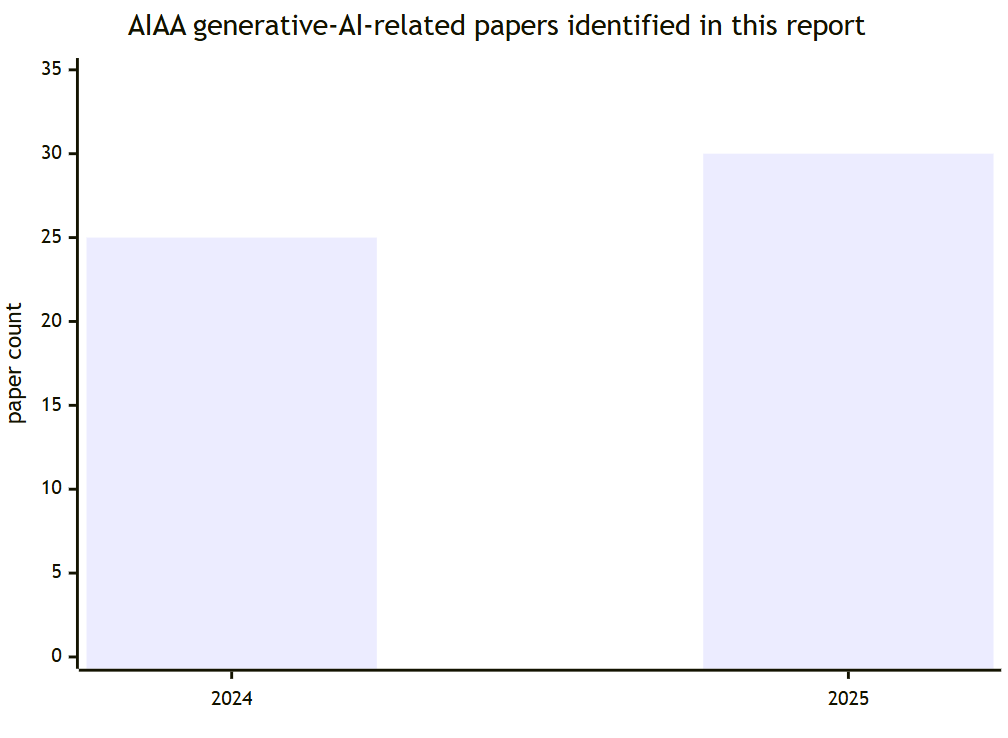
The inventory indicates a slight year-over-year increase from 2024 to 2025 in the subset captured by the keyword-based sweep (25 → 30 papers). This is largely driven by growth in explicit AI-driven CFD application papers and multi-agent / operator-agent framing, while “LLM-assisted workflows” remains steady in raw count. 59
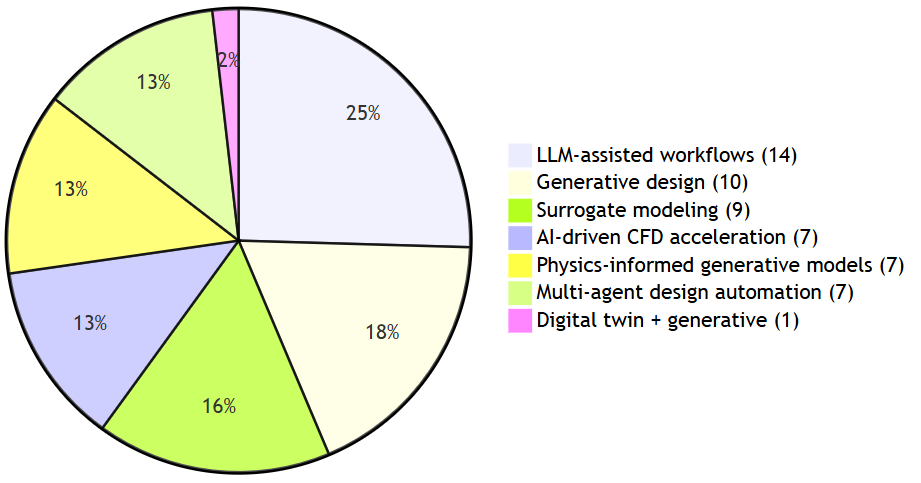
Category share is dominated by LLM-assisted workflows (benchmarks, RAG, fine-tuning, tool-support), followed by generative design (GAN/DDPM/diffusion geometry or design-space synthesis) and a near-tie between surrogate modeling and AI-driven CFD acceleration. 4
Category share (primary category) in the identified 2024–2025 set
A consistent technical pattern in geometry-generative papers is conditioning on performance targets (lift/drag/moment; constraints) while maintaining geometric validity. Diffusion-based airfoil sampling highlights data-efficiency and latent validity constraints 1; DDPM for BWB synthesis similarly conditions on global aero coefficients. 60 Physics-constrained GAN methods push further by explicitly attempting to map into a feasible region for constraints (e.g., eVTOL takeoff profiles), illustrating an emerging direction: “generative model as constraint-satisfying reparameterization.” 56
For turbomachinery-adjacent workflows, the most actionable 2024–2025 thread is LLM/agent orchestration of high-fidelity analysis: a Model Context Protocol server coupled to an LLM client to drive geometry creation, meshing, simulation, optimization, and visualization in a conversational loop. 7 This is complemented by provenance-aware, token-window-aware workflow management with open-weight agents. 45 Together, these suggest that near-term turbine value may come from automation, reproducibility, and human-in-the-loop acceleration, rather than fully autonomous blade-shape diffusion in the open literature.
Autonomous multi-agent turbine design architecture
mermaidコピーするflowchart TD
    A[Requirements & constraints intake\n(certification, operability, manufacturability)] --> B[RAG/Knowledge base\nstandards, past designs, test reports]
    B --> C[LLM Planner / Orchestrator\n(tool calling, decomposition)]
    A --> C

    C --> D[Geometry agent\n(blade/vane/endwall/cooling)]
    C --> E[Meshing agent\n(topology, y+, quality, automation)]
    C --> F[Solver agent\n(RANS/URANS/LES + adjoint)]
    C --> G[Surrogate/ROM agent\n(VAE/NO/NN; UQ-aware)]
    C --> H[Optimizer agent\n(MDO, constraints, robust design)]

    D --> E --> F --> I[Results store + provenance]
    F --> I
    G --> H --> I

    I --> J[Verification & guardrails\nconstraint checking, plausibility, hallucination filters]
    J --> C

    I --> K[Validation loop\nrig tests, cascades, hot-gas tests]
    K --> I

    subgraph "Where surveyed papers map"
      C1[(2024-2773)]:::p --> C
      C2[(2024-0917, 2025-0701, 2025-1791)]:::p --> C
      B1[(2025-0700, 2025-3442, 2025-1916)]:::p --> B
      D1[(2024-2013, 2024-3755, 2025-3292)]:::p --> D
      G1[(2024-0685/0686, 2025-3799)]:::p --> G
      F1[(2025-0695/0696/0699, 2025-1467)]:::p --> F
      H1[(2025-3802, 2025-2775)]:::p --> H
    end

    subgraph "Gaps to reach industrial TRL"
      X1[End-to-end constraint guarantees\n(geometry+flow+stress+thermal+manufacturing)]:::gap
      X2[UQ + robustness as first-class objective\nacross multi-fidelity]:::gap
      X3[Closed-loop experimental validation integration\n(test stands + data assimilation)]:::gap
      X4[Certification-grade traceability\n(provenance, audit trails, governance)]:::gap
      X5[Operator-agent safety\n(LLM reliability under time-critical ops)]:::gap
    end

    J --> X5
    H --> X1
    G --> X2
    K --> X3
    I --> X4

    classDef p fill:#eef,stroke:#66f,stroke-width:1px;
    classDef gap fill:#fee,stroke:#f66,stroke-width:1px;
Interpretation: surveyed work already covers (1) agentic orchestration of analysis pipelines (not turbine-specific but directly transferable), 7 (2) RAG/graph grounding and trust as a technical counterweight to hallucination, 4 (3) generative parameterizations for airfoils and aircraft configurations, 1 and (4) solver acceleration via physics-informed methods and ML-in-the-loop AMR. 61 The gaps are primarily about verification + validation + governance and about scaling to multi-physics turbine realities.
Prompt analysis and improved prompts
Analysis of the general research prompt
Your general prompt is strong in its taxonomy (categories) and extraction schema (physics-integration, validation type, CFD-in-loop, agent coordination). The main weaknesses that reduce retrieval depth and reproducibility are:
First, it needs a clear inclusion/exclusion boundary for “surrogate models,” because that term is too broad in AIAA proceedings; without guardrails, the search explodes into hundreds of generic ML surrogate papers. (In this report, we constrained surrogates to those explicitly using generative/latent models, physics-informed operators, or solver-acceleration framing.) 62
Second, it should explicitly request searching by the AIAA DOI pattern 10.2514/6.2024-* and 10.2514/6.2025-* and by meeting paper IDs (AIAA 2024-XXXX, AIAA 2025-XXXX) because those strings appear in many AIAA-accessible metadata lines and in downstream repositories. 31
Third, the validation dimension should split “simulation” into at least: (a) pure offline dataset experiments, (b) simulator-in-the-loop optimization, and (c) high-fidelity CFD/adjoint loops. This matters because papers range from data-only language modeling 3 to end-to-end CFD + FEA optimization pipelines with an LLM front-end. 7
Analysis of the turbomachinery-focused prompt
Reconstructing the likely goal: a turbomachinery prompt should force discovery of papers that touch (i) geometry generation for blades/vanes/endwalls, (ii) aero/thermal/structural constraints, (iii) CFD/adjoint integration, (iv) experimental validation (cascades, rigs), and (v) workflow automation at scale.
The largest missing dimension is turbomachinery-specific vocabulary (compressor/turbine stage, endwall contouring, tip clearance, film cooling, secondary flows, loss models, operability/stall margin, blade heat transfer, conjugate heat transfer, stress/creep/fatigue) combined with generative keywords. Without that, search drifts toward airfoils and generalized aerospace geometry.
The second missing dimension is CAD/mesh representation (NURBS, splines, implicit SDF, mesh deformation, topology constraints, watertight CAD) which is central for turbine manufacturing and solver robustness. That omission prevents separating “pretty generative shapes” from “CFD-usable and manufacturable geometries.”
Improved prompt wording
Improved general prompt (retrieval + extraction)
Search AIAA meeting papers from 2024–2025 (SciTech; Aviation/ASCEND; Propulsion & Energy; and other AIAA meeting-paper venues) for generative AI and agentic workflows. Use DOI patterns
10.2514/6.2024-*and10.2514/6.2025-*plus keywords: diffusion/DDPM/score-based, GAN/cGAN/AAE/VAE, normalizing flow, neural operator, PINN/PINO, transformer generation, LLM, RAG, knowledge graph, tool calling, multi-agent, workflow engine, digital twin.
For each confirmed paper, return: title; authors; year; venue; DOI; (if available) author PDF/arXiv/NASA/AFRL/MIT link. Extract (with evidence quotes or “unspecified”): model type + conditioning, geometry representation, physics coupling (PDE residuals, constraints, adjoint, solver-in-loop), validation tier (offline dataset vs CFD/adjoint vs experiment), uncertainty handling, deployment maturity signals (prototype system, integrated tool, operator study), and whether multi-agent coordination exists (planner/executor/critic; provenance).
Classify into: generative design; physics-informed generative models; surrogate modeling; multi-agent design automation; AI-driven CFD acceleration; LLM-assisted workflows; digital twin + generative. Require a structured table and trend summaries.
Improved turbomachinery-focused prompt (for AIAA submission targeting)
Focus on turbomachinery (compressor/turbine/fan) and adjacent propulsion aero-thermal design. Search AIAA 2024–2025 meeting papers using combined keyword blocks:
(A) Generative/agentic: diffusion/DDPM/score-based, GAN/cGAN/AAE/VAE, flow matching, normalizing flow, transformer generation, RL policy generation, LLM/RAG/agentic/tool calling, multi-agent.
(B) Turbomachinery: turbine stage, compressor stage, blade/vane, endwall contouring, tip clearance, film cooling, secondary flows, loss, efficiency, stall margin, operability, heat transfer, conjugate heat transfer, cooling passage, stress/creep/fatigue, manufacturing constraints.
(C) Representations: CAD, NURBS/splines, CST, Bézier, SDF/implicit, mesh deformation, graph meshes, unstructured mesh quality, y+.
For each paper found: extract whether geometry is direct vs parameterized; whether CFD/adjoint is in-the-loop; whether constraints are enforced in-model (physics-informed / feasibility mapping) versus post-check; whether experiments are included (cascade/rig/hot gas); whether UQ is reported; and whether an agent team coordinates CAE steps with provenance/audit trails. Output: comparison table, institution map, and identified gaps for industrial TRL.
Strategic insights and research directions for industrial turbine applications
The 2024–2025 AIAA evidence suggests a pragmatic path for turbines: agentic automation + provenance + solver acceleration is maturing faster than end-to-end generative blade synthesis. Workflow engines explicitly target the difficulty of reliably converting natural language into correct engineering actions at scale, including multi-agent approaches and context management—highly relevant to turbine design environments where a single “design iteration” spans many tools and constraints. 45 In parallel, physics-informed solvers and ML-augmented CFD components are moving toward integration inside simulation workflows (e.g., shock processing, super-resolution–guided AMR), which is directly applicable to compressor and turbine flow predictions. 36
However, industrial adoption hinges on three missing capabilities: (1) constraint guarantees that cover aero/thermal/structural/manufacturing simultaneously (beyond “feasible in surrogate space”), 8 (2) rigorous, experiment-linked validation loops, and (3) certification-grade traceability and reliability modeling for agentic systems—especially as AIAA papers themselves caution about reliability in time-critical settings. 46
Five AIAA-suitable research directions and paper ideas
Feasibility-Mapped Diffusion for Turbine Blade Sections with Manufacturing Constraints
Concept: Build a conditional diffusion model generating turbine blade sections (or 2.5D stacks) conditioned on loading and thickness/cooling/clearance constraints, but train it to output samples in a feasible manifold akin to the “feasible-space transform” logic demonstrated for physicsGAN-style constraints. 63
Required simulations/experiments: RANS (and selected URANS) evaluations across operating envelope; manufacturing constraint checks (minimum radii, thickness bounds); optional cascade tests for a small subset.
TRL target: prototype (integrated generator + verification + CFD evaluation loop).
Multi-Agent Turbine Design Orchestrator with Provenance and Audit Trails
Concept: Extend provenance-aware workflow management with an LLM planner/executor/critic team to run a full turbine iteration: CAD update → meshing → solver run → post-processing → constraint report → optimization step. Use the MCP-style tool-calling pattern and provenance strategies from AIAA workflow management papers. 7
Required simulations/experiments: Demonstrate on a public/industrial-like turbine stage case with repeated runs; quantify failure modes, recovery strategies, and reproducibility.
TRL target: prototype (tool integrated; operator-in-the-loop).
Physics-Informed Neural Operator Surrogates for Turbine Stage Flowfields with Uncertainty Quantification
Concept: Adapt physics-informed transformer/neural-operator techniques to turbine passages (high curvature, secondary flows), explicitly measuring generalization to new boundary conditions and geometry perturbations. 33
Required simulations/experiments: LES/RANS multi-fidelity dataset for a reduced turbine stage set; incorporate UQ (ensembles or Bayesian approximations) to quantify risk for design decisions.
TRL target: research → prototype depending on integration into a design loop.
Trust-Grounded Turbine “Design Copilot” Using GraphRAG + Believability Metrics
Concept: Combine domain RAG over turbine design rules, test reports, and CFD best practices with intrinsic trust/believability scoring methods (embedding–knowledge graph alignment) to mitigate hallucination, and evaluate under adversarial prompts (“wrong units,” “unsafe setting”). 47
Required simulations/experiments: Controlled evaluation set (like ALUE-style but turbine-specific) with ground-truth answers and penalized hallucinations; user study with engineers. 5
TRL target: prototype (internal decision-support tool).
Hybrid Generative Cooling Passage Design with CFD-in-the-Loop AMR Acceleration
Concept: Use generative models (VAE/GAN/diffusion) to propose internal cooling passage topologies under manufacturability limits, and couple evaluation to CFD using super-resolution–assisted AMR to reduce turnaround time. 64
Required simulations/experiments: Conjugate heat transfer simulations with realistic boundary conditions; validate select designs via lab tests (e.g., scaled cooling coupons).
TRL target: prototype (demonstrated speedup + validated thermal metrics).
A publicly available paper (PDF)
Following only 2 papaers are avairable.

コメント